Interview with Nicolas Barrois (team manager at 1. FC Saarbrücken-TT): “Our time with Fan has been incredibly beneficial for us as a club”
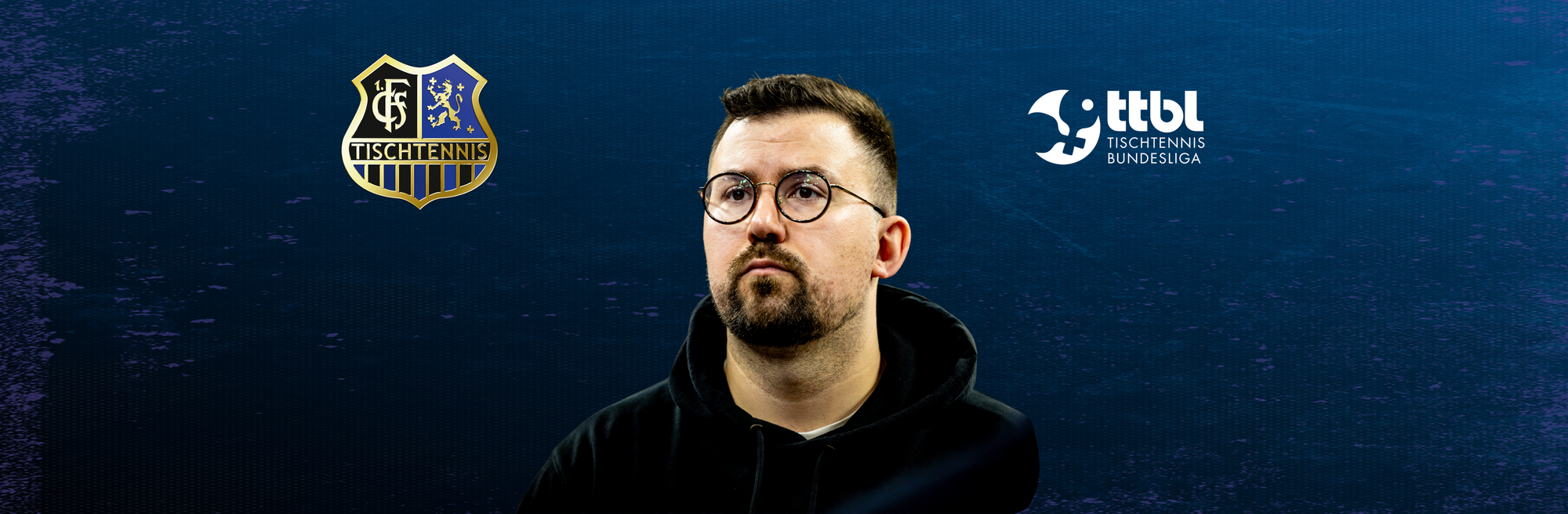
At the end of the season, 1. FC Saarbrücken-TT will have to let their superstar Fan Zhendong move to league rivals Borussia Düsseldorf. In this interview, FCS team manager Nicolas Barrois discusses the Saarland club’s perspective on the transfer, the lessons the club has learnt from an exciting season, and new goals for the future.
Nicolas Barrois, in football, a club’s efforts to keep a player are often described as a battle. Have 1. FC Saarbrücken-TT and you also lost a battle with Fan Zhendong’s move to Borussia Düsseldorf?
Of course we fought to keep him. On the other hand, it’s quite different from football: there was no back-and-forth haggling or tug-of-war; instead, the clubs simply stated what they were offering, what they envisaged, and presented their proposals. I believe that, ultimately, we didn’t lose the battle; rather, the appeal of Borussia Düsseldorf over the past decades – or rather, that of Timo Boll – tipped the balance. I also simply believe that, as has been communicated, Fan Zhendong wants to see more of Europe and gain further experience.
In mid-February, in an update on the talks in Saarbrücken with Fan, you spoke of a “very good offer” for your superstar. Why, in your view – setting aside the differences in tourism between Saarbrücken and Düsseldorf – was the offer not good enough for Fan to continue his career in Saarbrücken?
I don’t believe our offer wasn’t good enough. I actually think Timo played a major role in the whole process through his charisma and his relationship with Fan Zhendong, which is perhaps so special that Fan also wants to experience playing in Düsseldorf. We’ve always said ourselves that Düsseldorf has been the leading team in Europe for years. We’ve been countering that somewhat for a while now and have managed to win the odd title, but ultimately Düsseldorf is still a force in table tennis.
In interviews regarding Fan’s future, you’ve been discussing both possibilities – Fan stays or Fan leaves – since the end of last year. Did you also have in mind that ‘leaving’ could mean a move within the TTBL?
Yes, of course we were also aware that Fan didn’t have to go back to China, but could move to another club in Europe or even in Germany. He was quite open about it and told us straight out that he had several offers. The fact that he’s now moving to a direct rival isn’t perhaps ideal, but we’re professional enough to accept that. We don’t hold it against the player either.
Your comments have always suggested that you would accept Fan’s departure at the end of the season without complaint, despite Saarbrücken’s immense efforts over the past few months. But doesn’t his move to Saarbrücken’s biggest rival on both the German and European stage hurt at least a little more than, say, a return to China, which was also a conceivable option?
Well, when a player leaves us whom we actually wanted to keep, that naturally always hurts. Accordingly, a move to a direct rival in the Champions League and the Bundesliga naturally hurts us fans – especially in the case of a player of his calibre. But we are now focusing on the tasks ahead, we’re not dwelling on the past, and we don’t feel any envy whatsoever. We’re focusing on this season now, and come next season, we’ll see that we’ll try to make life as difficult as possible for his new club and for him – despite all the goodwill and friendship we’ve built up over the past year.
What was your first thought when you heard the news of his move to Düsseldorf?
My first thought was, of course, disappointment. Disappointment at losing him, at losing Fan Zhendong the person, whom we’d grown fond of and who’d felt so welcome here. But I must also say that immediately afterwards, the focus shifted to what happens next. Things move very quickly in professional sport, and table tennis is now a very fast-paced game too. With twelve teams, it feels as though every player has played for a rival club at some point.
How did Fan’s teammates in your squad react to the news of his departure? And how did your future top player, Hugo Calderano, take the news?
It’s obviously not pleasant news for our lads. We’re facing a massive upheaval. We’d, of course, informed the players in advance that Fan hadn’t signed a new contract yet. So none of them assumed that Fan was definitely staying. That dampened the lads’ expectations a bit, as it was clear that there was a chance Fan might not be playing for us next year. Once the decision had been made, there wasn’t much disappointment, anger or frustration. Everyone seemed determined that we’d go into the next season fighting – even if we’re the underdogs.
Fan’s move adds a bit of spice to both Saarbrücken’s Champions League Final4 home match in mid-May and, potentially, the TTBL Final4 two weeks later, as your team could face Fan’s future club, Düsseldorf, on both occasions. Would you want to be in Fan’s shoes in these situations?
Of course, it’s a special situation. But I also believe that this first year in Germany is something very, very special for Fan Zhendong, and that he is professional enough to shake it off and still want to deliver his best performance. We still have big plans and want to achieve them together with him, to make his first season something very, very special and to give him the send-off we all deserve after the effort we’ve put in this season. That’s why I’m confident that there won’t be any particular impact, regardless of who we end up playing.
But doesn’t a transfer just before the crunch time of the season also mean unrest at a potentially inopportune moment?
No, because we’ve known about it for a few weeks now. That meant we could prepare for it, and the players had a chance to process it all a bit. Besides, before the final matches, the focus is entirely on the sporting side of things anyway, and any background noise doesn’t matter.
Following the Bundesliga finals, the “Fan Zhendong era” has already come to an end for Saarbrücken. What are Saarbrücken’s most valuable lessons, both as a club and as a team, from this challenging period?
We have achieved something that not many clubs in Germany or Europe would manage: we have integrated such an exceptional player into our ranks and succeeded in providing him with a secure and professional environment. We did everything we could to make that happen. We got everything up and running with the help of our volunteers. Without staff, without a huge team, but entirely with volunteers. We’d also like to thank everyone who really worked their fingers to the bone all year round. We’re also taking away what we can from what we’ve achieved with two, three, four events attracting between 2,000 and a good 3,500 spectators – that was absolutely brilliant fun. But it was also challenging, and as a result we’re taking away an incredible amount from it – a great deal of positivity and a real sense of what can be achieved when we stick together. That’s a very, very positive aspect of this story: we’re a club that can handle anything.
To what extent has the TTBL also been able to benefit from the ‘fan effect’?
I believe that it’s not just the TTBL, but the whole of German table tennis that has benefited from this. We’ve put in a tremendous amount of work to ensure that table tennis is once again the talk of the town. When you look at the news reports across Europe and around the world – it’s been brilliant. Viewership figures have reached record highs so far this season, and the big matches haven’t even taken place yet. That’s why I believe that all of us together, including the TTBL clubs where he played, have done a good job. There were record crowds everywhere. It was great fun, and I think he enjoyed it immensely too.
Would you go through with the “Fan Zhendong project” again or not? And why?
We’d definitely want to go through with it again – otherwise we wouldn’t have wanted to keep him. Overall, the time with Fan Zhendong has been a huge benefit for us as a club; we’ve grown, we’ve created more professional structures, and we’ve learnt a lot. We’ve had to learn the hard way at times, but we’d still do it all over again in a heartbeat. It was absolutely brilliant fun, and we’d actually hoped that we could take it up a notch with Hugo and him together. Unfortunately, that’s not how it’s turned out, but if the opportunity arises in the future to sign a top player, a top Chinese player, then we’d certainly give it some thought.
Fan is Saarbrücken’s fourth departure of the season, following Darko Jorgic, Cedric Meissner and Yuto Muramatsu. Given that Saarbrücken has for years been a prime example of continuity, will FCS now become a club like many others in the wake of this unusually extensive shake-up?
We are aware that a complete shake-up is taking place. We have stood for continuity for years. This will be very unfamiliar territory for us. We hope the fans will support us through this. We hope we can find our feet as a team. In my opinion, we have a good selection of players who all know each other well, who are a mix of experience and youthful exuberance. They will get on well together, and I believe that we will continue to play a significant role in the race for titles.
When announcing the fans’ farewell, you mentioned discussions regarding the team’s strategic direction. What options were or are generally on the table?
There are, of course, several factors we’re considering at the moment. Should we sign another player, or give young players more opportunities? Perhaps something will happen, perhaps not. Last year, our squad planning was already finalised when the opportunity to sign Fan Zhendong arose. That goes to show you should never say never; things move so quickly in sport, so even if squad planning is complete, you shouldn’t turn down a player like Fan Zhendong. Fortunately, we didn’t make that mistake and have gained a great deal of positive from it. If another top player comes along on 31 May, we won’t turn him down, even if contract negotiations are probably no longer possible. Fundamentally, however, we are also very, very satisfied with the team we have now put together.
You’ve described the new team as competitive even with just Calderano and Patrick Franziska. Given their packed international schedule, will both of them still be available often enough to support title ambitions?
Of course, the WTT is a strain on the players; there are a lot of fixtures. But generally speaking, I’d say that our team is extremely competitive, even with Alvaro Robles and Eddy Ionescu. Both players have been playing in the Bundesliga for several years now, and they consistently deliver good results on the international stage; plus, we’ve got two young players in the back line as well. There will certainly be enough stability to be competitive in all competitions. Particularly in the competitions where the path to a final isn’t so long, we naturally want to put in a very, very good performance.
Can you already set out goals for the new season at this stage?
Our very clear goal is to go as far as possible in the Champions League and the Cup, and to cause trouble for the favourites in some way. In the Bundesliga, we want to give the young players the chance to prove themselves. If that works out like it did this season in Ochsenhausen and a player really hits form, then you’re very quickly in the mix for the Final4. With Hugo and ‘Franz’, we naturally have two absolute key players who can make the difference in these matches. So overall, we want to be in contention for the titles in all three competitions again. We’ll have to wait and see how that plays out in a Bundesliga season spanning 22 matchdays.
Thank you very much for talking to us, Nicolas Barrois.
Florian Manzke