Desmond Douglas, ‘King’ Kong, Fan Zhendong: Major transfers
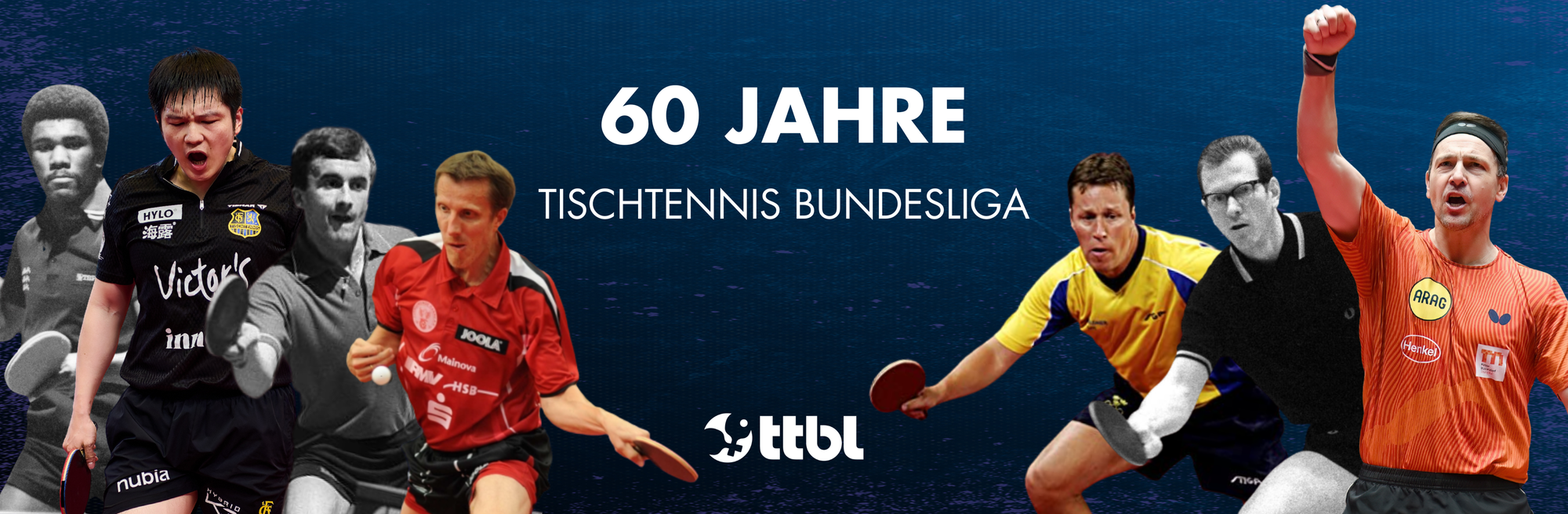
The German Table Tennis Bundesliga (TTBL) has reason to celebrate: Germany’s top division is now in its 60th season and, to mark this anniversary, is more attractive and of a higher standard than ever before. In the run-up to its ‘birthday’ in September 2026, this space will regularly feature milestones in the development of the top flight into what is now the strongest league in Europe. In the fourth instalment of this journey through an era of German sporting history, we look back at spectacular transfers in the top flight.
Superstar Fan Zhendong made spectacular transfer headlines in the TTBL for the second time in ten months back in March. Both the Chinese player’s spell at 1. FC Saarbrücken-TT, which is now drawing to a close after a single season, and his recently announced move to Borussia Düsseldorf for the coming season brought the TTBL worldwide attention.
But of course, Fan’s move is by no means the first sensational transfer in the Bundesliga’s nearly 60-year history. However, players who have won Olympic gold are still a rarity in the German top flight.
By signing for Saarbrücken around a year ago, Fan became the first ‘reigning’ Olympic champion to play in the Bundesliga in 26 years. Prior to the champion of the 2024 Summer Games in Paris, ‘King’ Kong Linghui had joined TTF Bad Honnef in 1999 for a second spell in Germany as a newly crowned world doubles champion, following Fan’s compatriot’s Olympic gold in the doubles in Atlanta three years earlier. Kong’s partner, Liu Guoliang, had also won the singles tournament at the Summer Games 30 years ago, and so, just a few weeks after his double triumph in the USA, he brought a particularly golden glow to his “debut” at TTC Jülich.
At the time, Jülich had virtually specialised in ‘importing’ world-class talent from the Middle Kingdom. For three years before Liu, Wang Tao had become the first Olympic champion from China to join the border region club, having won Olympic gold in the doubles with Lu Lin in Barcelona in 1992, as well as the World Championship titles in the doubles, mixed doubles and team events just a few months before his move to Jülich. Twelve months after Wang, his doubles partner Lu joined the former European Cup winners for a season in 1994.
Jan-Ove Waldner was the only Olympic champion from Europe to compete in the German elite league. However, the Swedish icon – who had already been under contract with ATSV Saarbrücken in the 1980s – did not sign for SV Plüderhausen until 2003, eleven years after winning his singles gold in Barcelona, and later joined TTC RhönSprudel Fulda-Maberzell. Following Waldner’s departure from the East Hessian club in 2012, South Korea’s Athens Olympic champion Ryu Seung-Min brought a touch of gold to TTF Liebherr Ochsenhausen for two years.
The most spectacular transfer of a home-grown star was not Timo Boll’s long-awaited move from TTV Gönnern to Düsseldorf in 2007, but Steffen Fetzner’s 14 years earlier. The departure of the 1989 doubles world champion from Düsseldorf, alongside his long-time doubles partner Jörg Roßkopf, to the then-newcomer team Super-Donics Berlin caused quite a stir.
Düsseldorf had also been at the centre of headline-grabbing club transfers involving German stars many years earlier. In 1968, Borussia lured top German player Eberhard Schöler away from their successful local rivals TuSA Düsseldorf with ‘professional perks’ and, by signing ‘Mr Pokerface’ – in hindsight – laid the foundations for securing a permanent place among the national elite. When, a year later, blocking specialist Wilfried Lieck also moved from SVM Essen to the North Rhine-Westphalian metropolis, Düsseldorf also made a name for itself as “Borussia Germany”.
It was the Rhinelanders who also provided the first significant boost to the league’s appeal through international star players. In 1977, Düsseldorf signed the Jamaican-born Englishman Desmond Douglas – and hit the jackpot: thanks to his spectacular style, Douglas became a nationwide crowd favourite and a major draw for spectators. Above all, the “high earner” proved to be the guarantee of success everyone had hoped for during his eight years in the Borussia shirt, winning five titles – his annual salary, estimated at 50,000 marks, was also an important step in the Bundesliga’s professionalisation process.
Florian Manzke